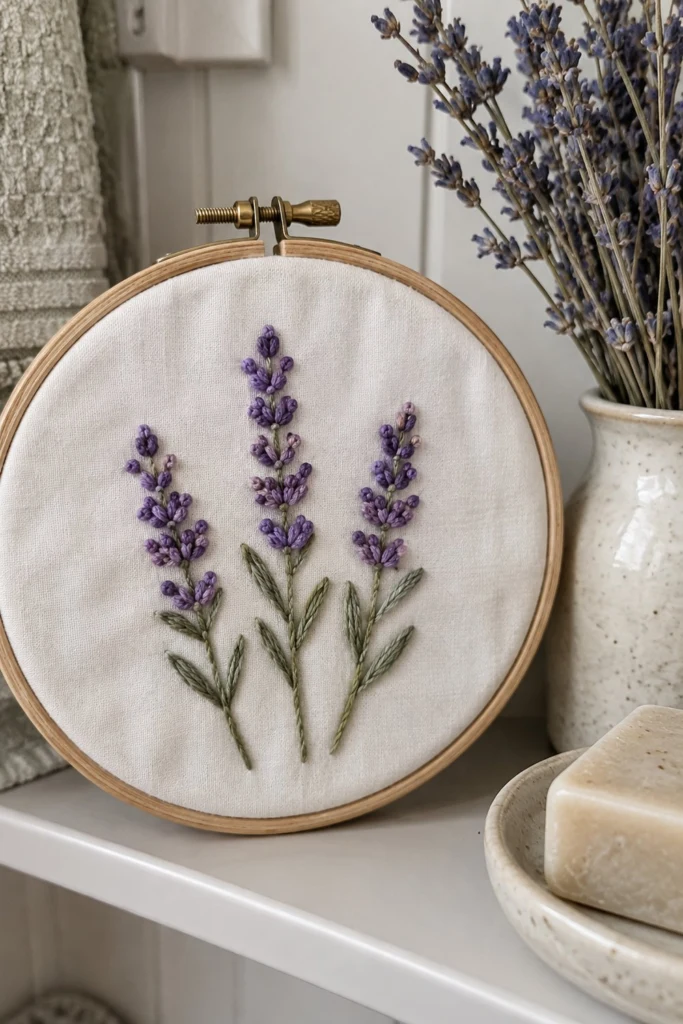
Three delicate sprigs of lavender sit quietly inside a 4 in (10 cm) wooden hoop, stitched with soft purples and muted greens on natural cotton. This little floral embroidery piece brings a touch of calm to a bathroom shelf or a quiet corner, and it makes a satisfying weekend project if you enjoy working with texture.
Quick Facts
Skill level: Beginner friendly
Finished size: 3 in x 3 1/2 in (7.5 cm x 9 cm) inside the hoop
Hoop: 4 in (10 cm) wooden embroidery hoop
Fabric: Cream cotton-linen blend, cut to 8 in x 8 in (20.5 cm x 20.5 cm)
Stitches used: Stem stitch, lazy daisy, French knot
Time to make: 3 to 4 hours
What Makes This Hoop Art Special
The flowers are built almost entirely from French knots, which gives the lavender buds a wonderful, bumpy texture that stands right off the fabric. The stems use a steady stem stitch to keep the lines clean, while a few lazy daisy stitches at the base of the stems form the small green leaves. It is a quick project that relies on simple, repetitive stitches rather than complicated techniques.
Finished Size
The stitched design measures 3 in wide by 3 1/2 in high (7.5 cm wide by 9 cm high) and sits centered inside a 4 in (10 cm) embroidery hoop.
Materials You Will Need
- Cream cotton-linen fabric: 1 piece cut to 8 in x 8 in (20.5 cm x 20.5 cm)
- Embroidery hoop: 4 in (10 cm)
- Embroidery needle: Size 5 or 7 sharp embroidery needle
- Embroidery scissors: Small, sharp snips
- Water-soluble transfer pen
- Cotton embroidery floss (six-strand skeins):
| Colour name |
DMC number |
Strands |
Used for |
Skeins |
| Pale Lavender |
3824 |
2 |
Top buds |
1 |
| Medium Lavender |
553 |
2 |
Middle buds |
1 |
| Dark Purple |
3740 |
2 |
Lower buds |
1 |
| Muted Green |
3053 |
2 |
Stems and leaves |
1 |
Stitches Used
Stem Stitch
- Bring the needle up through the fabric on the line, then take a small stitch forward along the line.
- Keep the working thread below the needle as you pull it through.
- Bring the next stitch up just to the side of the previous stitch hole, keeping the thread on the same side.
French Knot
- Bring the needle up through the fabric where you want the knot.
- Wrap the thread around the needle two times, holding the tail taut with your non-dominant hand.
- Insert the needle back into the fabric very close to where it came out, leaving a tiny gap.
- Pull the needle slowly through to the back while holding the thread tail until the knot sits flat.
Lazy Daisy
- Bring the needle up at the base of the loop.
- Insert the needle back down right next to that first hole, leaving a loose loop on top.
- Bring the needle up a short distance away at the tip of the petal, catching the loop inside the needle point.
- Pull gently to form the petal shape, then anchor it with a tiny stitch over the loop.
Transferring the Design
The design consists of three vertical stems of lavender. The center stem is the tallest, rising from 1 1/2 in (3.8 cm) above the bottom edge of the fabric to 1 in (2.5 cm) below the top edge. The left stem sits about 3/4 in (1.9 cm) to the left of the center stem, and the right stem sits about 3/4 in (1.9 cm) to the right, both slightly shorter.
To copy the design, place your fabric over a printed template or sketch it directly onto the fabric using a water-soluble transfer pen. You can also tape your fabric to a bright window with the reference image behind it and trace the lines gently with the pen.
Stitching Instructions
1. Stems
Thread your needle with two strands of Muted Green (DMC 3053). Work the three vertical stems from the base upward using the stem stitch. Keep your stitches even and close together so the lines look smooth and natural.
2. Leaves
Using two strands of Muted Green (DMC 3053), stitch a pair of lazy daisy leaves near the lower section of each stem. Angle them slightly outward to look like real lavender foliage.
✅ Checkpoint: All three stems and their leaves are complete. Your green work is finished, and the piece should measure about 3 1/2 in (9 cm) tall from the bottom tips of the stems to the top of the center line.
3. Lower Bud Clusters
Thread your needle with two strands of Dark Purple (DMC 3740). Fill the lower third of each flower spike with dense French knots, clustering them tightly around the upper portion of each stem.
4. Middle Bud Clusters
Switch to two strands of Medium Lavender (DMC 553). Work French knots in the middle section of each flower spike, blending them slightly into the darker purple knots below.
5. Top Bud Clusters
Finish the very top of each sprig with two strands of Pale Lavender (DMC 3824). Taper the French knots inward toward the tip of the stem so the flower head narrows naturally at the top.
✅ Checkpoint: All three lavender sprigs are fully filled with French knots, fading from dark purple at the bottom to pale lavender at the top.
Finishing the Hoop
Daub any visible blue pen marks gently with a damp cotton swab until they disappear completely. Let the fabric dry flat, then press it gently on the backside with a warm iron over a clean towel so you do not crush your French knots. Center your stitched fabric inside the 4 in (10 cm) wooden hoop, pull the edges taut, and tighten the screw at the top. Trim the excess fabric at the back to about 1/2 in (1.3 cm) and glue or stitch a running stitch around the raw edges to gather them neatly behind the inner ring.
Tips and Variations
If you want to use this pattern on a linen tea towel or the pocket of a canvas tote bag, skip the hoop entirely and mount your fabric in a larger hoop just for stitching. You can also swap the purples for soft pinks or buttery yellows if you want a different mood for your room.
FAQ
Can I use all six strands of embroidery floss?
Stick to two strands for both the stems and the French knots. Using all six strands will make the French knots too bulky and the stems too thick to look delicate.
What if my French knots keep turning into loose loops?
Make sure you keep the working thread taut with your left hand while you pull the needle through to the back with your right hand. Do not let go of the tail until the knot is pulled tight against the fabric.
How do I keep the fabric from slipping in the hoop?
Wrap a thin layer of cotton twill tape or bias binding around the inner ring of the hoop before placing your fabric over it. This gives the fabric extra grip so it stays tight while you stitch.
Happy Stitching!
I hope you enjoy stitching these little lavender sprigs as much as I did. If you make one, save the pin on Pinterest. If you make one, I would love to see it: send me a photo through the contact page.