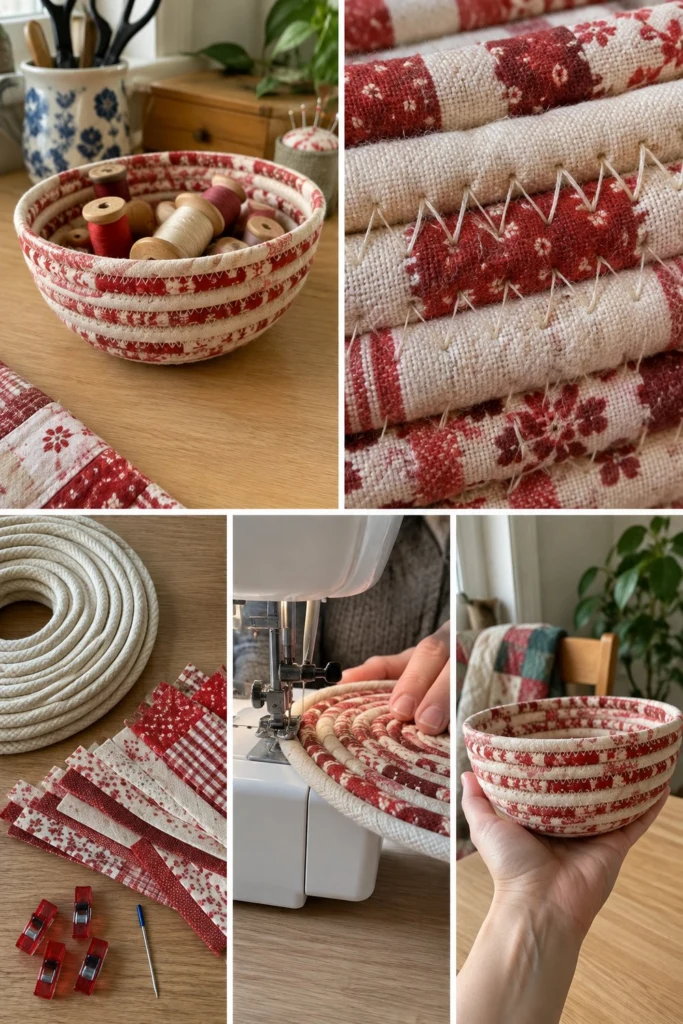
There is something wonderfully satisfying about turning a plain length of clothesline and some fabric scraps into a sturdy, useful basket on an ordinary sewing machine. This coiled rope bowl has a base that sits flat and sides that curve up naturally as you guide the spiral under the needle.
Quick Facts
- Skill level: Confident beginner
- Finished size: 7 in wide x 3 in high (18 cm x 7.5 cm)
- Fabric: 100% cotton fabrics and 1/4 in cotton clothesline
- Seam allowance: Handled by the zigzag stitch width
- Time to make: 2 hours
- Machine needed: Sewing machine with zigzag stitch capability
What Makes This Home Special
- The raw edges of the fabric strips stay hidden because you wrap them around the rope continuously as you sew.
- The 100/16 jeans needle punches through thick rope and layered fabric smoothly without breaking.
- The wide zigzag stitch catches both the current coil and the previous coil securely so the basket holds its shape without extra stiffener.
Finished Size
| Dimension |
Inches |
Centimetres |
| Finished width |
7 in |
18 cm |
| Finished height |
3 in |
7.5 cm |
| Base diameter |
5 in |
12.5 cm |
Materials You Will Need
| Material / Notion |
Amount (Imperial & Metric) |
Notes |
| Cotton clothesline |
900 in (23 m) |
1/4 in (6 mm) diameter, unbleached cotton |
| Fabric scraps |
Various prints |
Cut into 1 in (2.5 cm) wide strips on the bias |
| All-purpose thread |
1 spool |
To match or contrast with your fabric strips |
| Jeans sewing needle |
Size 100/16 |
Essential for piercing thick rope layers |
Tools: Sewing machine, fabric scissors, sewing clips or pins, tape measure.
Cutting List
Note: No traditional seam allowances apply here; width adjustments happen at the sewing machine.
| Piece |
Fabric |
Cut Size W x H |
How Many |
| Fabric strips |
Assorted scraps |
1 in x WOF (2.5 cm x WOF) |
As needed to reach 900 in |
| Cotton clothesline |
Cotton cord |
900 in (23 m) total length |
1 continuous length |
Before You Start
Cut your fabric scraps into 1 in (2.5 cm) wide strips. Cutting on the bias helps the fabric wrap smoothly around curves without bunching. Wind your bobbin fully, as coiled rope sewing uses up thread quickly. Insert a fresh size 100/16 jeans needle into your machine. Set your machine to a zigzag stitch, 5 mm wide and 2.5 mm long.
Step-by-Step Instructions
Step 1: Starting the Center Coil
Take one end of your 900 in (23 m) clothesline and wrap the end of a fabric strip tightly around the tip, covering all raw edges. Fold the very tip of the rope into a tight flat spiral, about 1 in (2.5 cm) across.
✅ Checkpoint: Your starting disc should lie completely flat on the table, measuring 1 in (2.5 cm) in diameter.
Step 2: Securing the First Turns
Place the flat spiral under the presser foot of your sewing machine. Lower the foot and take a few manual stitches using the 5 mm wide zigzag stitch to lock the center in place. Make sure the stitch catches both sides of the spiral loop.
Step 3: Wrapping and Sewing the Base
Begin feeding the rope through the machine while wrapping the fabric strip continuously around the bare rope just ahead of the needle. Keep feeding the rope in a counterclockwise spiral. Butt each new coil right up against the previous one so the zigzag stitch bridges across the gap, catching both coils firmly.
💡 Designer Tip: Keep a gentle, even tension on the rope as you feed it. Do not pull or push the rope through the machine; let the feed dogs do the work while you guide the circle.
Step 4: Reaching the Base Limit
Continue sewing in expanding circles until your flat base reaches 5 in (12.5 cm) across. Stop with the needle down in the work.
✅ Checkpoint: The flat spiral base should measure exactly 5 in (12.5 cm) across before you start turning the bowl upward.
Step 5: Tilting the Sides Up
To make the sides rise, gently tilt your flat spiral base upward at a 45-degree angle so it rests against the machine’s arm or your hand. As you continue sewing and wrapping fabric, the new coils will automatically stack slightly outside and above the previous ones rather than lying flat.
⚠️ Note: Support the weight of the growing bowl with your left hand so the stitches stay even and the rope does not pull out of alignment.
Step 6: Building the Bowl Walls
Continue sewing round and round, letting the walls flare outward slightly until the bowl reaches a height of 3 in (7.5 cm). Add new fabric strips by overlapping the ends as you run out, wrapping the next strip tightly over the tail of the previous one.
Step 7: Finishing the Rim
When the bowl reaches the desired height, taper the end of the rope by snipping away the core or feathering the last inch so it slants down to nothing. Wrap the very end neatly with your final fabric strip and sew it down flush against the top edge. Backstitch a few times to secure the end, then trim your thread threads close.
✅ Checkpoint: The finished bowl measures 7 in (18 cm) wide at the top rim and 3 in (7.5 cm) high.
Finishing
Inspect your bowl and snip any stray thread tails. Press the bowl lightly with a steam iron if needed to set the shape of the cotton rope and fabric.
Size and Fabric Variations
- For a larger fruit basket: Continue the flat base spiral to 7 in (18 cm) across before tilting the sides up, and use about 1440 in (36.5 m) of clothesline.
- For solid color bowls: Use continuous strips of a single fabric rather than mixing scraps.
Care Instructions
Spot clean your rope bowl with a damp cloth and mild soap. Do not submerge in water or put in the washing machine, as the cotton rope core can warp and lose its shape. Air dry completely.
FAQ
What sewing machine needle should I use?
Always use a size 100/16 jeans needle. Regular universal needles can bend or break when punching through thick cotton cord and layered fabric.
Why won’t my bowl sit flat?
If your starter spiral was curved instead of flat, the whole base will cup. Rip out the first few stitches, flatten the center disc completely on the table, and start the zigzag stitching again.
Can I use synthetic rope instead of cotton?
Cotton clothesline works best because the cotton fibers grip the fabric strips and hold the zigzag stitches securely. Synthetic rope is too slippery and the thread tends to slide off.
Happy Sewing!
I hope you enjoy turning simple cord and scraps into a lovely handmade bowl for your sewing room. Save this pin on Pinterest so you can find it later, and send me a photo of your finished bowl through my contact page—I always love seeing what you make!